NASA InSight landed 4 degrees tilted on Mars :
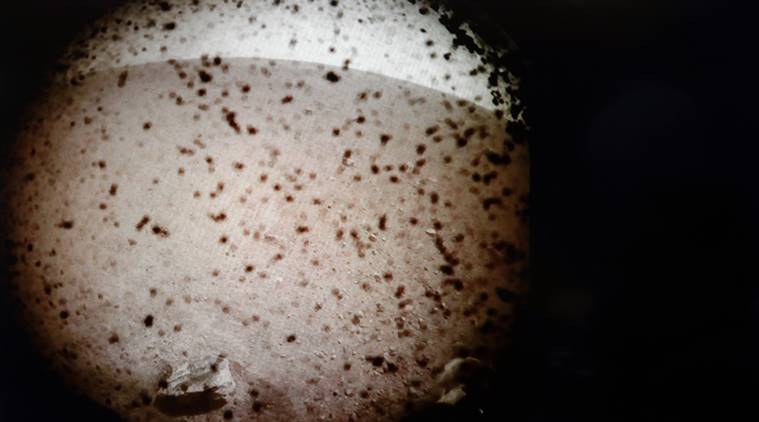
A image transmitted from Mars by the InSight lander is seen on a computer screen at NASA’s Jet Propulsion Laboratory. (Image: NASA)
Though NASA’s InSight landed safely on the surface of Mars, but the spacecraft sits about 4 degrees tilted, the US space agency said. Early last week, InSight touched down on a lava plain named Elysium Planitia on the Red Planet. The vehicle sits tilted slightly in a shallow dust-and sand-filled impact crater known as a “hollow”. But, InSight has been engineered to operate on a surface with an inclination up to 15 degrees, NASA said in a statement on Friday.
“The science team had been hoping to land in a sandy area with few rocks since we chose the landing site, so we couldn’t be happier,” said InSight project manager Tom Hoffman at NASA’s Jet Propulsion Laboratory (JPL) in California. “There are no landing pads or runways on Mars, so coming down in an area that is basically a large sandbox without any large rocks should make instrument deployment easier and provide a great place for our mole to start burrowing,” he added.
Rockiness and slope grade factor into landing safety and are also important in determining whether InSight can succeed in its mission after landing. According to the team, rocks and slopes could affect InSight’s ability to place its heat-flow probe — also known as “the mole” or HP3 — and ultra-sensitive seismometer, known as SEIS, on the surface of Mars. But, a preliminary assessment of the photographs taken so far of the landing area suggests the area in the immediate vicinity of the lander is populated by only a few rocks. Higher-resolution images are expected to begin arriving over the coming days, after InSight releases the clear-plastic dust covers that kept the optics of the spacecraft’s two cameras safe during landing.
“We are looking forward to higher-definition pictures to confirm this preliminary assessment,” said JPL’s Bruce Banerdt, principal investigator of InSight. “If these few images – with resolution-reducing dust covers on – are accurate, it bodes well for both instrument deployment and the mole penetration of our subsurface heat-flow experiment.”
Data downlinked from the lander also indicate that during its first full day on Mars, the solar-powered InSight spacecraft generated more electrical power than any previous vehicle on the surface of Mars, NASA noted. Launched from Vandenberg Air Force Base in California on May 5, InSight will operate on the surface for one Martian year plus 40 Martian days, or sols — the equivalent of nearly two Earth years. InSight will study the deep interior of Mars to learn how all celestial bodies with rocky surfaces, including Earth and the Moon, formed.
Though NASA’s InSight landed safely on the surface of Mars, but the spacecraft sits about 4 degrees tilted, the US space agency said. Early last week, InSight touched down on a lava plain named Elysium Planitia on the Red Planet. The vehicle sits tilted slightly in a shallow dust-and sand-filled impact crater known as a “hollow”. But, InSight has been engineered to operate on a surface with an inclination up to 15 degrees, NASA said in a statement on Friday.
“The science team had been hoping to land in a sandy area with few rocks since we chose the landing site, so we couldn’t be happier,” said InSight project manager Tom Hoffman at NASA’s Jet Propulsion Laboratory (JPL) in California. “There are no landing pads or runways on Mars, so coming down in an area that is basically a large sandbox without any large rocks should make instrument deployment easier and provide a great place for our mole to start burrowing,” he added.
Rockiness and slope grade factor into landing safety and are also important in determining whether InSight can succeed in its mission after landing. According to the team, rocks and slopes could affect InSight’s ability to place its heat-flow probe — also known as “the mole” or HP3 — and ultra-sensitive seismometer, known as SEIS, on the surface of Mars. But, a preliminary assessment of the photographs taken so far of the landing area suggests the area in the immediate vicinity of the lander is populated by only a few rocks. Higher-resolution images are expected to begin arriving over the coming days, after InSight releases the clear-plastic dust covers that kept the optics of the spacecraft’s two cameras safe during landing.
“We are looking forward to higher-definition pictures to confirm this preliminary assessment,” said JPL’s Bruce Banerdt, principal investigator of InSight. “If these few images – with resolution-reducing dust covers on – are accurate, it bodes well for both instrument deployment and the mole penetration of our subsurface heat-flow experiment.”
Data downlinked from the lander also indicate that during its first full day on Mars, the solar-powered InSight spacecraft generated more electrical power than any previous vehicle on the surface of Mars, NASA noted. Launched from Vandenberg Air Force Base in California on May 5, InSight will operate on the surface for one Martian year plus 40 Martian days, or sols — the equivalent of nearly two Earth years. InSight will study the deep interior of Mars to learn how all celestial bodies with rocky surfaces, including Earth and the Moon, formed.
Comments
Post a Comment