Tiny Si Time silicon MEMS resonator hits     5ppb accuracy for 5G infrastructure: 
SiTime-Emerald-mems-ocxo


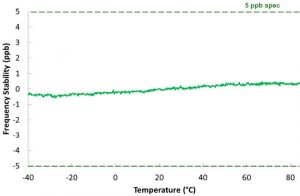
Mems oscillator from has announced devices that can achieve 5ppb (parts/billion) frequency accuracy, and shun both thermal variation and vibration.

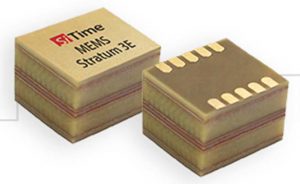
The devices are based on 100 ppb parts released two years ago and, despite now including an oven, measure 7 x 9 x 6.5 mm.

The firm is aiming frequency provision in 5G infrastructure, where many mini-base stations will be spread across the landscape, in less-protected locations compared with 3G or 4G base stations – on lamp posts, for example, which will be exposed to more vibration and thermal variation.“We can achieve ±50ppt/°C typical frequency slope, which is 10x better than any quartz OCXO we have seen,” Si Time v-p of marketing Piyush Sevalia told Electronics Weekly. “Vibration resistance is ±0.1 ppb/g, 10-20 times better than and quartz we have seen.”
With this level of temperature protection, according to Sevalia, the oscillator can be placed almost anywhere on a PCB, and there is no need to add airflow deflectors – fans turning on and off have been known to modulate the frequency output of telecoms OCXOs, he said, adding that the devices temperature performance comes down to an insulated oven as well as compensation.  Allan deviation is 2e-11 under airflow
Vibration resistance comes down to the minuscule mass of the silicon resonator. “The amount of energy that couples in is small,”said Sevalia.
Adding the oven has increased power consumption, to 650 mA compared with 40 mA through the earlier 100 ppb non-oven part, which is also smaller at 5 x 3.2 mm.
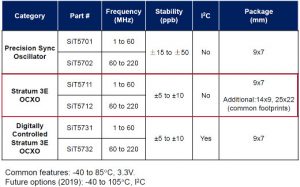
An internal phase-locked loop means output frequency is variable and can be programmed across 1-60 MHz or 60-220 MHz depending on variant.
Operation is across -40 to +85°C, with -40 to +95°C and -40 to +105°C versions in the pipeline.
On-board regulation of the power supply increases rejection of rail-based influences, and removes the need for external ferrite, to a figure not released at the time of writing. “We expect to be very good, since we use the same circuit architectures and technologies as past platforms,” said Sevalia.
SiTime-Emerald-mems-ocxo
Output options are LVCMOS or clipped sine-wave.
Versions for telecoms will be available meeting Stratum 3E specs, which include:
  • 20-year free running accuracy of +/-4.6 ppm
  • 24 hour holdover of ±10 ppb inclusive of temperature effects
  • 1 ppb/day (in ±5°C) recommendation
The technology behind the ovened oscillators has been branded ‘Emerald Platform’.
Emerald samples are available now for qualified customers, with production quantities scheduled to available in Q2 2019.


Comments

Popular posts from this blog

Dark matter may be older than the Big Bang

Dark matter, which researchers believe make up about 80% of the universe's mass, is one of the most elusive mysteries in modern physics. What exactly it is and how it came to be is a mystery, but a new Johns Hopkins University study now suggests that dark matter may have existed before the Big Bang. The study, published August 7 in  Physical Review Letters , presents a new idea of how dark matter was born and how to identify it with astronomical observations. "The study revealed a new connection between particle physics and astronomy. If dark matter consists of new particles that were born before the Big Bang, they affect the way galaxies are distributed in the sky in a unique way. This connection may be used to reveal their identity and make conclusions about the times before the Big Bang too," says Tommi Tenkanen, a postdoctoral fellow in Physics and Astronomy at the Johns Hopkins University and the study's author. While not much is known about its origins,...

Home births as safe as hospital births: International study suggests

A large international study led by McMaster University shows that low risk pregnant women who intend to give birth at home have no increased chance of the baby's perinatal or neonatal death compared to other low risk women who intend to give birth in a hospital. The results have been published by  The Lancet 's  EClinicalMedicine  journal. "More women in well-resourced countries are choosing birth at home, but concerns have persisted about their safety," said Eileen Hutton, professor emeritus of obstetrics and gynecology at McMaster, founding director of the McMaster Midwifery Research Centre and first author of the paper. "This research clearly demonstrates the risk is no different when the birth is intended to be at home or in hospital." The study examined the safety of place of birth by reporting on the risk of death at the time of birth or within the first four weeks, and found no clinically important or statistically different risk between home...

GSAT-11 satellite to be launched from French Guiana on Dec 5th

GSAT-11 satellite to be launched from French Guiana on Dec 5th GSAT-11 would be located at 74 East and is the fore-runner in a series of advanced communications satellite with multi-spot beam antenna coverage over Indian mainland and Islands, ISRO said. GSAT-11 is the next generation “high throughput” communication satellite configured around ISRO’s I-6K Bus. (PTI/Representational). Indian space agency ISRO is scheduled to launch GSAT-11, the “heaviest” satellite built by it, on-board Ariane-5 rocket of Arianespace from French Guiana on December 5. Weighing about 5,854 kg, GSAT-11 would play a vital role in providing broadband services across the country, and also provide a platform to demonstrate new generation applications, the Indian Space Research Organisation (ISRO) said. It is the “heaviest” satellite built by ISRO, the space agency said. GSAT-11 is the next generation “high throughput” communication satellite configured around ISRO’s  I-6K Bus, and it...