Renesas prepares RX65N MCU for new robot protocol ROS 2:
Renesas is aiming at industrial robots by adding support for DDS-XRCE (data-distribution service for extremely resource constrained environments), one of the protocols planned for the ROS 2 communication standard.
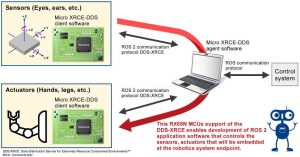
Renesas-RX65N-DDS-XRCE-for-ROS-2
Specifically an XRCE-DDS client (‘Micro XRCE-DDS’ from eProsima) has been implemented on Renesas’ 32bit RX65N MCUs.
“Robot Operating System – ROS – is a key framework that provides libraries and tools that enable developers to bring innovations to the robotics community,” said the firm. “There has been new interest in extending ROS access to embedded MCUs, which accelerates the development of service robots. The development of the ROS 2 addresses these needs. Support of DDS-XRCE enables development of software that controls the sensors and actuators that will be embedded at robotics system endpoints, such as welfare, safe guard, reception, cleaning and household robots.”
In a demonstration, Renesas linked two RX65N-based boards using DDS-XRCE, a sensor board acting as robot eyes and ears, and an actuator board operating its hands and legs. According to the firm, software used in this demonstration will be open-sourced later this year.

Comments

Popular posts from this blog

Dark matter may be older than the Big Bang

Dark matter, which researchers believe make up about 80% of the universe's mass, is one of the most elusive mysteries in modern physics. What exactly it is and how it came to be is a mystery, but a new Johns Hopkins University study now suggests that dark matter may have existed before the Big Bang. The study, published August 7 in  Physical Review Letters , presents a new idea of how dark matter was born and how to identify it with astronomical observations. "The study revealed a new connection between particle physics and astronomy. If dark matter consists of new particles that were born before the Big Bang, they affect the way galaxies are distributed in the sky in a unique way. This connection may be used to reveal their identity and make conclusions about the times before the Big Bang too," says Tommi Tenkanen, a postdoctoral fellow in Physics and Astronomy at the Johns Hopkins University and the study's author. While not much is known about its origins,...

Home births as safe as hospital births: International study suggests

A large international study led by McMaster University shows that low risk pregnant women who intend to give birth at home have no increased chance of the baby's perinatal or neonatal death compared to other low risk women who intend to give birth in a hospital. The results have been published by  The Lancet 's  EClinicalMedicine  journal. "More women in well-resourced countries are choosing birth at home, but concerns have persisted about their safety," said Eileen Hutton, professor emeritus of obstetrics and gynecology at McMaster, founding director of the McMaster Midwifery Research Centre and first author of the paper. "This research clearly demonstrates the risk is no different when the birth is intended to be at home or in hospital." The study examined the safety of place of birth by reporting on the risk of death at the time of birth or within the first four weeks, and found no clinically important or statistically different risk between home...

GSAT-11 satellite to be launched from French Guiana on Dec 5th

GSAT-11 satellite to be launched from French Guiana on Dec 5th GSAT-11 would be located at 74 East and is the fore-runner in a series of advanced communications satellite with multi-spot beam antenna coverage over Indian mainland and Islands, ISRO said. GSAT-11 is the next generation “high throughput” communication satellite configured around ISRO’s I-6K Bus. (PTI/Representational). Indian space agency ISRO is scheduled to launch GSAT-11, the “heaviest” satellite built by it, on-board Ariane-5 rocket of Arianespace from French Guiana on December 5. Weighing about 5,854 kg, GSAT-11 would play a vital role in providing broadband services across the country, and also provide a platform to demonstrate new generation applications, the Indian Space Research Organisation (ISRO) said. It is the “heaviest” satellite built by ISRO, the space agency said. GSAT-11 is the next generation “high throughput” communication satellite configured around ISRO’s  I-6K Bus, and it...