
EMI suppression film capacitors to AEC-Q200

EMI suppression film capacitors to AEC-Q 200:

Vishay has introduced automotive grade X2 EMI suppression film capacitors for 50 and 60Hz.
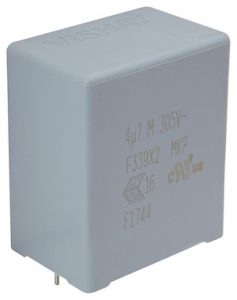
Vishay-F339X2-305VAC
Called F339X2 305VAC, the series is qualified to both AEC-Q200 (rev D) and IEC 60384-14: 2013 / AMD1: 2016 grade IIB.

To comply with the new humidity grading in IEC 60384-14: 2013 / AMD1: 2016 grade IIB, the series withstands a temperature humidity bias (THB) testing of 85°C, 85% RH for 500 hours at rated voltage “with high stability on capacitance and dissipation factors”, which translates into greater robustness and longer service life in harsh application conditions, claims the firm. Intended applications are in EMC filters for automotive and industrial power inverters. Capacitors lead pitches choice is 15, 22.5 or 27.5mm and capacitors span 0.1μF to 4.7μF – with tolerances down to ±10% and a permissible dc voltage of 630V. Encapsulation is a flame-retardant UL-class 94 V-0 plastic case with an epoxy resin seal. Pb-free devices are RoHS-compliant. Samples and production quantities of the new X2 capacitors are available now.

Comments

Popular posts from this blog

Home births as safe as hospital births: International study suggests

A large international study led by McMaster University shows that low risk pregnant women who intend to give birth at home have no increased chance of the baby's perinatal or neonatal death compared to other low risk women who intend to give birth in a hospital. The results have been published by  The Lancet 's  EClinicalMedicine  journal. "More women in well-resourced countries are choosing birth at home, but concerns have persisted about their safety," said Eileen Hutton, professor emeritus of obstetrics and gynecology at McMaster, founding director of the McMaster Midwifery Research Centre and first author of the paper. "This research clearly demonstrates the risk is no different when the birth is intended to be at home or in hospital." The study examined the safety of place of birth by reporting on the risk of death at the time of birth or within the first four weeks, and found no clinically important or statistically different risk between home...

Dark matter may be older than the Big Bang

Dark matter, which researchers believe make up about 80% of the universe's mass, is one of the most elusive mysteries in modern physics. What exactly it is and how it came to be is a mystery, but a new Johns Hopkins University study now suggests that dark matter may have existed before the Big Bang. The study, published August 7 in  Physical Review Letters , presents a new idea of how dark matter was born and how to identify it with astronomical observations. "The study revealed a new connection between particle physics and astronomy. If dark matter consists of new particles that were born before the Big Bang, they affect the way galaxies are distributed in the sky in a unique way. This connection may be used to reveal their identity and make conclusions about the times before the Big Bang too," says Tommi Tenkanen, a postdoctoral fellow in Physics and Astronomy at the Johns Hopkins University and the study's author. While not much is known about its origins,...

Scientists challenge notion of binary sexuality with naming of new plant species

A collaborative team of scientists from the US and Australia has named a new plant species from the remote Outback. Bucknell University biology postdoctoral fellow Angela McDonnell and professor Chris Martine led the description of the plant that had confounded field biologists for decades because of the unusual fluidity of its flower form. The discovery, published in the open access journal  PhytoKeys , offers a powerful example of the diversity of sexual forms found among plants. The new species of bush tomato discovered in remote Australia provides a compelling example of the fact that sexuality among Earth's living creatures is far more diverse -- and interesting -- than many people likely realize. Bucknell University postdoctoral fellow Angela McDonnell and biology professor Chris Martine led the study following an expedition last year to relocate populations of the new plant, which were first noted by Australian botanists during the 1970s. Herbarium specimens from th...