
Driverless cars: Who should die in a crash?

Driverless cars: Who should die in a crash?


A driverless car

If forced to choose, who should a self-driving car kill in an unavoidable crash?
Should the passengers in the vehicle be sacrificed to save pedestrians? Or should a pedestrian be killed to save a family of four in the vehicle?
To get closer to an answer - if that were ever possible - researchers from the MIT Media Lab have analysed more than 40 million responses to an experiment they launched in 2014.
Their Moral Machine has revealed how attitudes differ across the world.

How did the experiment work?

Weighing up whom a self-driving car should kill is a modern twist on an old ethical dilemma known as the trolley problem.
The idea was explored in an episode of the NBC series The Good Place, in which ethics professor Chidi is put in control of a runaway tram.
If he takes no action, the tram will run over five engineers working on the tracks ahead.
If he diverts the tram on to a different track he will save the five engineers, but the tram will hit one other engineer who would otherwise have survived.
The Moral Machine presented several variations of this dilemma involving a self-driving car.
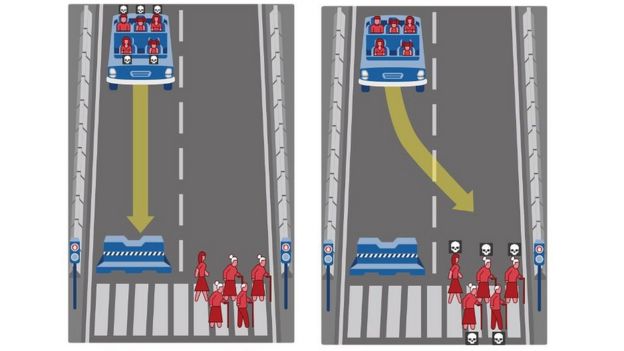
MIT Media Lab
People were presented with several scenarios. Should a self-driving car sacrifice its passengers or swerve to hit:
  • a successful business person?
  • a known criminal?
  • a group of elderly people?
  • a herd of cows?
  • pedestrians who were crossing the road when they were told to wait?
Four years after launching the experiment, the researchers have published an analysis of the data in Nature magazine.

What did they find?

The results from 40 million decisions suggested people preferred to save humans rather than animals, spare as many lives as possible, and tended to save young over elderly people.
There were also smaller trends of saving females over males, saving those of higher status over poorer people, and saving pedestrians rather than passengers.

Comments

Popular posts from this blog

Home births as safe as hospital births: International study suggests

A large international study led by McMaster University shows that low risk pregnant women who intend to give birth at home have no increased chance of the baby's perinatal or neonatal death compared to other low risk women who intend to give birth in a hospital. The results have been published by  The Lancet 's  EClinicalMedicine  journal. "More women in well-resourced countries are choosing birth at home, but concerns have persisted about their safety," said Eileen Hutton, professor emeritus of obstetrics and gynecology at McMaster, founding director of the McMaster Midwifery Research Centre and first author of the paper. "This research clearly demonstrates the risk is no different when the birth is intended to be at home or in hospital." The study examined the safety of place of birth by reporting on the risk of death at the time of birth or within the first four weeks, and found no clinically important or statistically different risk between home...

Dark matter may be older than the Big Bang

Dark matter, which researchers believe make up about 80% of the universe's mass, is one of the most elusive mysteries in modern physics. What exactly it is and how it came to be is a mystery, but a new Johns Hopkins University study now suggests that dark matter may have existed before the Big Bang. The study, published August 7 in  Physical Review Letters , presents a new idea of how dark matter was born and how to identify it with astronomical observations. "The study revealed a new connection between particle physics and astronomy. If dark matter consists of new particles that were born before the Big Bang, they affect the way galaxies are distributed in the sky in a unique way. This connection may be used to reveal their identity and make conclusions about the times before the Big Bang too," says Tommi Tenkanen, a postdoctoral fellow in Physics and Astronomy at the Johns Hopkins University and the study's author. While not much is known about its origins,...

Scientists challenge notion of binary sexuality with naming of new plant species

A collaborative team of scientists from the US and Australia has named a new plant species from the remote Outback. Bucknell University biology postdoctoral fellow Angela McDonnell and professor Chris Martine led the description of the plant that had confounded field biologists for decades because of the unusual fluidity of its flower form. The discovery, published in the open access journal  PhytoKeys , offers a powerful example of the diversity of sexual forms found among plants. The new species of bush tomato discovered in remote Australia provides a compelling example of the fact that sexuality among Earth's living creatures is far more diverse -- and interesting -- than many people likely realize. Bucknell University postdoctoral fellow Angela McDonnell and biology professor Chris Martine led the study following an expedition last year to relocate populations of the new plant, which were first noted by Australian botanists during the 1970s. Herbarium specimens from th...